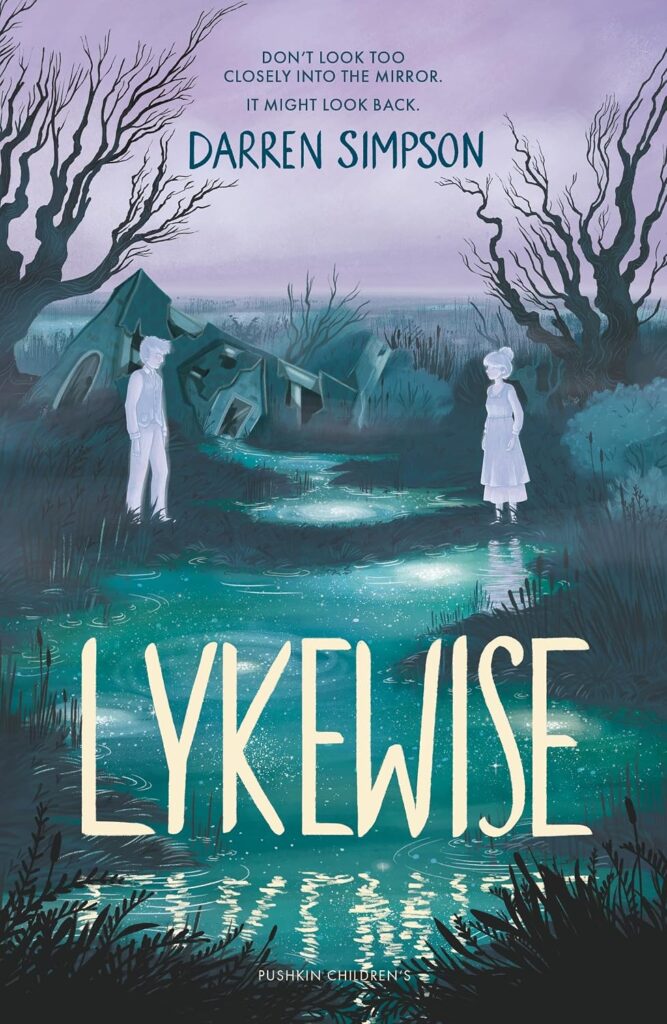
By Darren Simpson (pub. Pushkin Children’s Books, 2026)
‘Like for like, the wyrd is wise
Dare you look yourself in the eyes?
Try all you – ‘‘Stop.’
It was Dunn. Hetty threw him a sullen look. She was about to complain but Dunn cut her off with a raised finger.
‘Something’s wrong,’ he said. ‘Don’t you feel it?’
Dunn and his friends Beah and Hetty live in the village of Harrowmere; spread across islands in the boglands, it’s a place of fog and folklore, where you must be careful where you step. They don’t get many visitors out there.
While a travelling salesman leaves the villagers entranced with his mirrors, he also leaves the youngsters with a peculiar rhyme, one that promises to show your truest self if said between two of them. But who knows what might be looking back at you…
Note that there will be some spoilers, mainly about the creature, necessary to discuss aspects of the story.
Gosh, what a read!
We actually start the story at the point when its obvious things have gone wrong, though we don’t yet have the details. We get only a brief glimpse before we’re whisked back to the previous day. There are roughly 50 pages in this ‘flashback’, but every second is worth it, as we come back into the ‘now’ with more context, context that makes us worry about what’s coming next.
Hetty is bold and precocious, so it’s no wonder that she’s keen to try out the rhyme that the travelling salesman told them. Even after Dunn and Beah have left, unsettled, she feels the need to prove she can do it. What she didn’t expect was to see another Hetty within the mirror, one that steps through to take her place – and enact her ‘truest desire’. The Lykewise is not happy with just one however.
The creature has a method of changing form, meaning that the whole village is in danger. The tension this causes is palpable throughout the book; Simpson keeps us guessing by using the word “villager” until the newest likeness is revealed. I enjoyed seeing what actually happened to Hetty, and the Lykewise itself skulking around, as we’re normally kept in the dark like the protagonists.
Much like in John Carpenter’s classic horror The Thing, the villagers are isolated, with no easy way to escape, and uncertain of who to trust, lashing out at those they suspect. While the adults try to manage the situation, it’s up to Dunn and Beah to work out how to actually stop the creature.
Our main characters are around 12-13 years old, balancing the behaviour of children with the responsibility that comes from living in such a community. A lot of their character is informed by the situations in which they’ve grown up, especially given the comparison between Beah and Dunn’s families. I found myself with a lot of sympathy for both of them.
And since this is a world of folklore, it only makes sense that the kids would tell the adults what’s going on. I’m always a fan of stories where the adults take the young characters seriously, although in this one that’s both a blessing and a curse. The adults are needed to help track the Lykewise and keep others safe, but they are also the ones who have the power to lean into paranoia and make things much worse.
I adore British folklore, so it’s fantastic to see a children’s fiction book that plays so heavily into those themes. I read a book recently that described tales of giants dropping large rocks from their aprons, so when Simpson writes about the Causeway formed by a giant dropping rocks from his sack, I had a genuine moment of “wait, I know this!” (For those curious, the book is Cloven Country by Jeremy Harte, and it’s very good.)
The summoning of the Lykewise is another process that a lot of us would be familiar with. No doubt many of us have stood in front of a mirror on a dark night, dared to say “Bloody Mary” three times but then bottling it on the third – or maybe saying it, and having to pretend that we’re oh-so-cool and haven’t almost wet ourselves.
The Lykewise is born from those darkest thoughts that a person has, especially when they involve other people. It doesn’t have to be something they actually want to occur; it simply picks out the meanest, unkindest feelings they’ve had, and acts upon them. Annoyed by how someone plays with their hair? It cuts it off. But if you were jealous of someone’s drawing for example? Well, let’s just say it wouldn’t only break their pencils…
Although the Lykewise makes the darkest moments of their minds real, the story makes the point that these are the most extreme reactions. Most of us don’t actually want horrible things to happen to others. We may have a flash of annoyance, but those moments are perfectly natural; it’s what we do with those thoughts that matters. It’s actually quite a healthy message for a dark book!
Mirrors themselves are an excellent choice for a creepy story. They’ve been used for many a jump scare in movies, but have had a disconcerting quality for much longer due to the way they reverse the world. The travelling salesman is also not an unknown concept for scary tales. Here it reminds me of something from The Twilight Zone, or the works of horror veteran Ray Bradbury.
The story itself is incredibly well-paced. We watch the suspense build when the Lykewise takes action or a new form, unknown to the characters. And it doesn’t happen all at once; there are lulls which allow the villagers to make preparations (though they’re not really sure how), but which are also perfect for allowing them to spiral into suspicion.
Including an epilogue was an interesting choice. I’m normally not much of a fan, as it can feel like the author is just using them to tie up loose ends. That’s not the case here though. The ends are tied up in the main story, so the epilogue can focus on what the characters do next and the fallout for the village. It was a horrific experience that couldn’t help but affect them all, and it was satisfying to see the aftermath.
I love the use of the bogs; they’re really not something you see very often in children’s books, and when you do, they’re treated as a creepy place that just features at some point. The bogs of Harrowmere are the characters’ home, and are treated with the care and caution one would if they were regularly navigating them. The entire landscape is described so vividly.
The time setting is left relatively ambiguous. It’s obviously not modern, so avoids any of the issues that technology would bring to the story, but the mirrors are referred to as a mixture of glass and metal, meaning this is likely 16th Century or later when mirrors shifted to being made with mercury.
The one and only thing that I think the book could benefit from is a map. I loved how the islands of the village had different names as it felt very natural, but I’ll confess that seeing them in relation to each other might have been useful! (I realise this is somewhat of a ‘me’ problem, as I have aphantasia and so can’t picture things in my head.)
This is about as much as I can say without spoiling important story beats or character development, much though I would love to ramble on more about it! (Just ask my partner, who had to listen to me rave about as we walked along the windswept coast of Holy Island this past weekend.) Let’s just say that, as an adult fan of scary stories, I thought Lykewise was fantastic.
Although it’s a children’s book, it doesn’t oversimplify the emotions or reactions of the characters. It’s worth me raising that there are some quite dark moments in it – I literally gasped out loud at a couple of points – so it’s not for younger readers. I’d recommend 12+ for this one, especially if they aren’t easily spooked. The perfect choice for Halloween!
If you want to look in the mirror, you can grab a copy of Lykewise at the link below.
(Disclosure: If you buy books linked to our site, we may earn a commission from Bookshop.org, whose fees support independent bookshops.)
Looking for more folklore-based books? Check out some of our previous reviews here.
