
Written by Frances Hardinge and illustrated by Emily Gravett (pub. Two Hoots, PB 2026)
Old Ember had called her thoughts ‘burrs’, and that stung. Burrs were the enemy. Burrs were the secret infiltrators that could destroy everyone. She could have argued. She wanted to argue. Today, however, she couldn’t afford to draw attention to herself.
The unfamiliar weight of the object in her pocket banged against her hip. I’ll put it back soon, before anyone notices, she thought, hoping her face wasn’t flushing a guilty red.
Feather and her family live inside the Wall: a long, broken ruin that is the only safe place to stay away from the Forest that surrounds it on all sides. On a gathering mission outside, she meets a stranger and agrees to bring him back a particular item from the settlement.
But when things go awry, it’s up to Feather to journey along the Wall, facing the terrifying beasts and deadly foliage of the Forest. With only her scaled ferret Sleek to accompany her, what else might she find? And is there an end to the Wall?
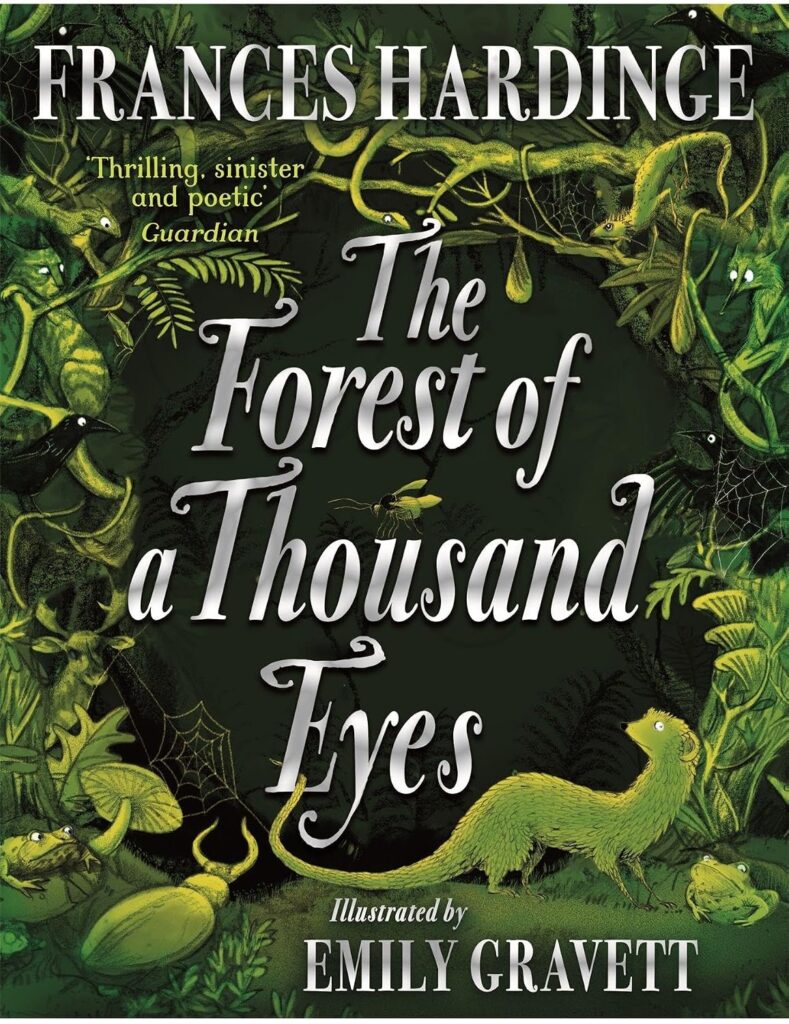
Well, what a childrens-book power couple! This is the second story from author Hardinge and illustrator Gravett, the first being 2023’s Island of Whispers (which I confess that I’m yet to read). They’re both award-winners, several times over, so it’s hardly a surprise that their collaboration would be as fantastic as it is.
In Feather’s world, there is Forest as far as the eye can see. The Wall where they live goes down a hundred feet to the treetops, and who knows how far below that. History tells them that the Forest pushed through the Wall and took over the towns and villages, leaving on/in the Wall itself as the only place to survive.
She and her family live in Greyman’s Gate where Feather is a ‘gatherer’, someone who goes outside in small groups to forage, although plants and seeds themselves cannot be allowed back in due to the danger they pose. The Forest is insidious; the Wall now stands in ruined sections, barely connected and almost impossible to traverse because of it.
Feather is an older child/teen, who makes a silly – but understandable – decision that kicks off the plot. Apart from Sleek, she adventures alone, which is a change from the majority of children’s books that see at least two kids working together. It feels somewhat unique for this, and at no point did I wish there was another protagonist to help carry the story.
Another unusual approach is that there’s no ‘twist’ about the outside world. I’ve read a number of books where the hero discovers that the world is not what it seems, and that there is a devasting truth being kept from the masses. And don’t get me wrong, they’re great! But that’s not so here – the Forest is incredibly deadly. There’s a moment when Sleek wakes Feather as the vines have started to curl around her that is genuinely gripping!
The life that Hardinge breathes into her descriptions of it are perfectly mirrored in the creeping vines and scuttling insects that make their way across many of the pages. I simply love the illustrations: they’re in black, white, greys, and greens, a perfect combination to impress upon the reader just how widespread – and encroaching – the Forest is.
(As a sidenote, there’s a moment where we’re told that Sleek only sees in “greens” and “not-greens”, and it made me wonder if our illustrations are like what he’s seeing! He may be tame, but the short sections we get to see inside his mind show he definitely hasn’t lost his animal instincts.)
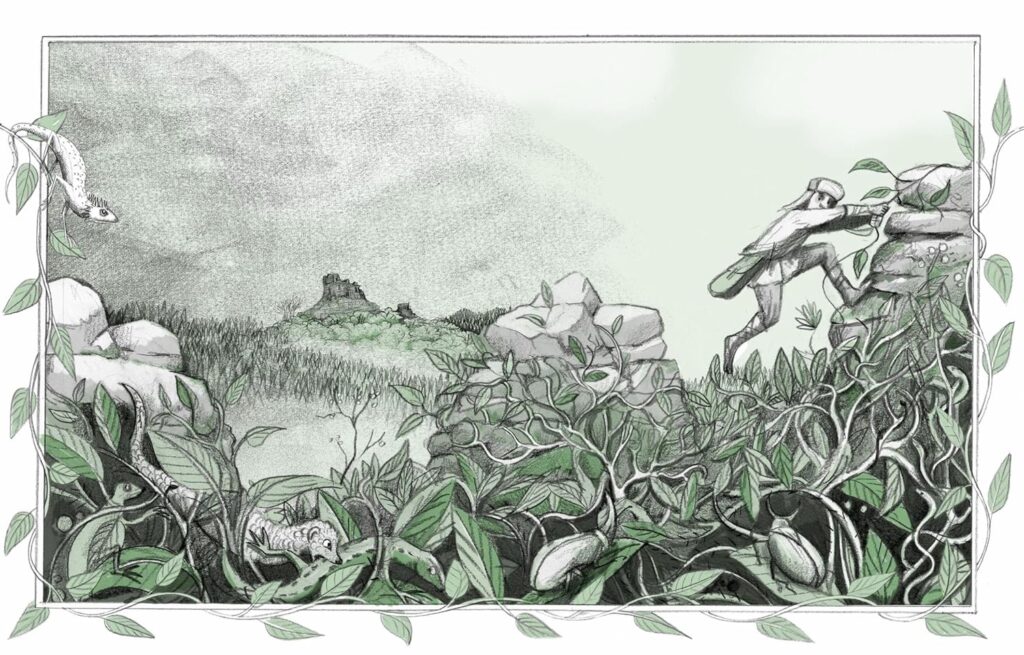
Every chapter gets at least one full-page illustration, often more, as well as half-pages throughout. There are also a number of double-page spreads, often showing the settlements. I absolutely adored these, and it was nice to see the places that didn’t get a full image still on the record of the journey at the end of the book. It would be interesting to know if all the places were drawn, and then some of them chosen for full-pages. or if it happened the other way around.
The use of colour becomes particularly marked when Feather has to go below the treeline. The illustrations still use their green palette, but the page colour reverses to be white text on a black background. It’s a striking contrast to the rest of the book, lending the images a much darker tone to suit the situation.
Reading the story itself almost feels like reading The Odyssey. There are points where Feather doesn’t know if she’s going the right way, or needs to go off course in order to get back on track, that felt quite stressful! She sees majestic landscapes, and hides from dangerous creatures. She visits strange settlements, and meets a variety of people, some who help her and some who hinder her.
It’s this last bit that gives us our strongest theme of the book. We’re variously told that the Wall fell due to infighting, or people not doing their part to defend it. The settlements that remain are fragmented, struggling to survive with their niche skills and inventories, separated by the ruins of a Wall that nobody crosses. But what happens if someone does? Maybe all we need do is reach out to one another.
The direction of the story may look linear, but the route it takes is definitely not – and I loved every minute of it.
If you want to journey across the Wall, you can grab a copy of The Forest of a Thousand Eyes at the link below.
(Disclosure: If you buy books linked to our site, we may earn a commission from Bookshop.org, whose fees support independent bookshops.)
Looking for more stories of adventure? Check out our previous reviews here.
