
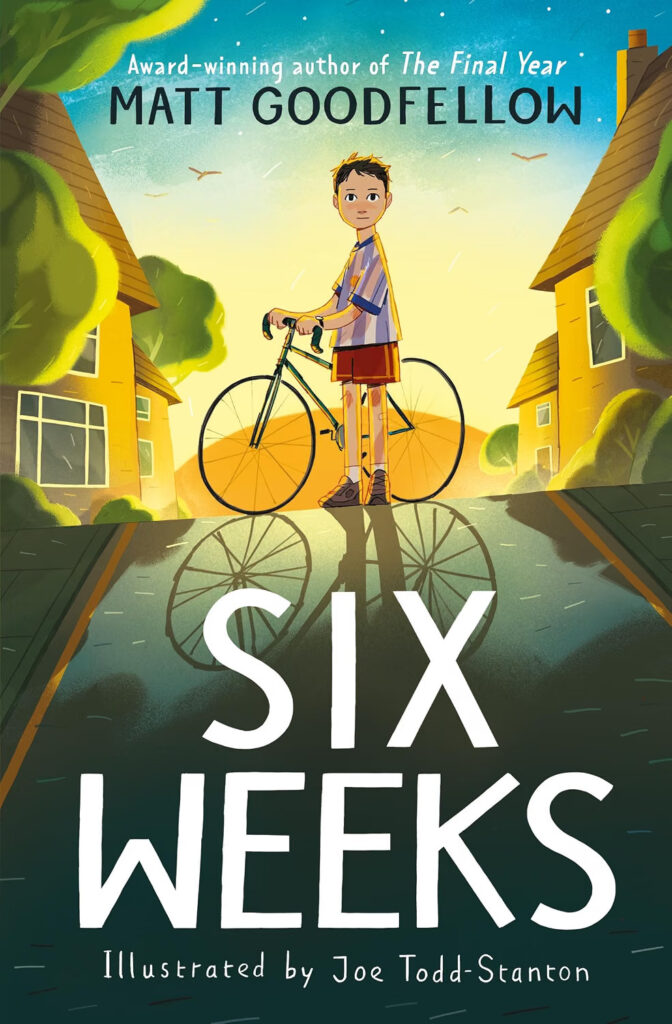
Written by Matt Goodfellow, illustrated by Joe Todd-Stanton (pub. Starboard, 2026)
And I have a couple of questions
which I know you can’t answer,
nobody can.But I need to ask them anyway.
Why did this happen to me?
And what do I do now?The only thing I do know
is I’ll never see Mum again.
Alfie feels lost since his mum died. He doesn’t know how to cope with the hurt, and the guilt that he wasn’t there when she passed. His mum’s family and friends don’t call, and his own friends don’t really know how to talk to him anymore.
It’s a year later, and the pain is still as strong. With six weeks of summer stretching out ahead of him, he knows that if he can just get outside on his bike then he can lose himself for a while. And you never know where the road might lead you…
Alfie’s parents separated when he was three, and he’s twelve at the start of the book. Both of his parents remarried; his father’s wife Sophie is a supportive and thoughtful step-parent, whereas his mother’s husband…well, he seems to hate Alfie, and the feeling is mutual.
Alfie feels guilty, not just for not being there when his mum Sally died, but also because he’d been distracted by school and the imminent birth of his half-sister on his dad’s side. Sally was diagnosed with terminal cancer, given a few months to live, and he thought there was time. She passed only two weeks later, and he was by her side instead.
Although he still has one side of the family, his mum Sally was his light. Things weren’t always easy, and she wasn’t always the most responsible parent, but Alfie loved her dearly. A mindless bike ride leads him back to her house, where he still lives. They never got on before, but of course things have changed since then. It’s up to them to decide where they go from there.
Six Weeks is the most recent of Goodfellow’s verse novels, stories that are narrative but that utilise the white space and lyrical format of poetry. They’re especially good for reluctant readers as they tend towards shorter lines and unusual formatting, making them more accessible and visually stimulating.
Here, Alfie is speaking directly to us, almost like a diary or as if we’re hearing one side of a conversation. The ongoing plot is punctuated with stories and memories from before this summer, as if Alfie is monologuing and simply adding bits in as and when he remembers them.
We’re getting a direct line into his thoughts and feelings, most notably when they concern his mother’s husband, who is only referred to as he or him (yes, with the bolded font). It’s a deliberate show of distance and dislike, echoed in the illustrations where he is a figure drawn entirely in shadow.
The illustrations are kept simple and poignant, used in some of the most emotional moments. There’s a depth of feeling in them, whether it’s his mum in a hospital bed or Alfie standing at the top of Mam Tor, their style portraying a sense of gentleness even when things feel tough.
The story itself is a brutally honest portrayal not just of how it feels to lose a loved one and the desire to get away, but of how it changes those around you. Sally’s mum and sister seem to disappear, and all the promises of support at the funeral never materialise.
On top of this, Alfie sees his friendships slipping away. His friends don’t know what to say, and he doesn’t really know what to say to them either. He knows they feel awkward, and he doesn’t have the energy or motivation to engage with them.
I really liked how the adults don’t try to keep everything from him. There’s a general sense of “hmm, is he ready?” from them, but the truth is that he needs the context. There was a lot about his mum’s background that he didn’t know, a lot that informed her own actions and choices over the years. Once he receives that information, he is allowed to process things at his own speed, and to make his own decisions.
Books with difficult themes often feature adults not explaining things, which leads to mistrust and miscommunication. Although this is common in real life, it’s still nice to see a different approach here, one that allows him to choose how to move forward. The adults are concerned of course, but also show support and understanding.
The MVP here has to be Sophie, his dad’s wife. She is the emotional heart and maturity of the book. Although his dad is there being supportive, it’s Sophie who is giving him food for thought, gently alighting on the more difficult feelings he’s facing while giving him space to consider them.
He is of course cast as a villain, and it sounds like he rather was one. Time and loss can lead to personal reflection, but it’s what we do then that makes a difference. When Alfie sees him for the first time since the funeral, he makes some overtures, but it’s Alfie who steps through the door and really makes the decision to reach out. I don’t know if I’d have his courage.
It’s an emotional and beautiful story. Although it’s genuinely tragic in places, it’s also hopeful, showing us growth and how to move on with – rather than simply around – grief. It’s also about connecting with those who are also suffering, leaving space to open up and allow forgiveness.
And importantly, it doesn’t rush things. By taking place over six weeks, we can see this growth as it happens and how conflicted Alfie feels. We watch him wrestle with his feelings and his mother’s final request to him. We also see him talk through his struggles, which is so important. Others may not entirely understand, but at least he’s not alone.
There’s a list of resources in the back, mostly for youngsters dealing with grief and bereavement, which I always think is a good idea in books that deal with sensitive topics. It can be hard to talk to those we know when we’re struggling; sometimes talking to a stranger feels easier. Hopefully those reading the book won’t need them, but it’s good that they’re there in case.
If you want to spend the summer riding with Alfie, you can pick up a copy of Six Weeks at the link below.
(Disclosure: If you buy books linked to our site, we may earn a commission from Bookshop.org, whose fees support independent bookshops.)
Looking for more books that deal with grief? You can check out some of our previous book reviews here.
