

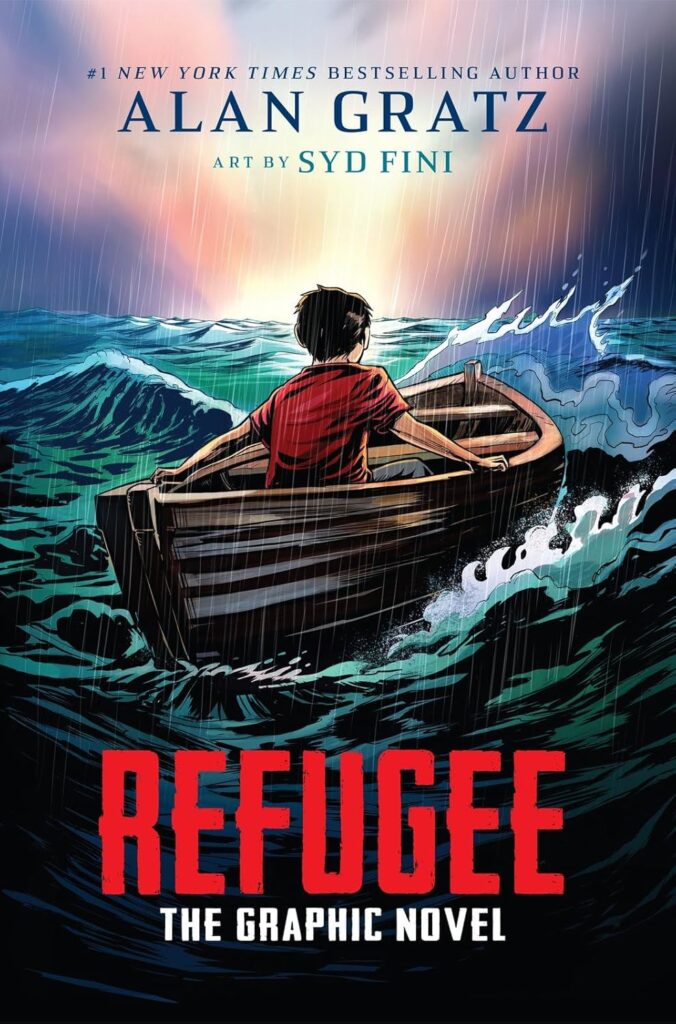
Written by Alan Gratz, illustrated by Syd Fini (pub. Scholastic Graphix, 2025)
I see it now, Chabela. All of it. The past, the present, the future.
All my life, I kept waiting for things to get better. For the bright promise of mañana.
But a funny thing happened while I waiting for the world to change. It didn’t. Because I didn’t change it.
I’m not going to make the same mistake twice.
Refugee: The Graphic Novel follows the stories of three different children and their families, as they seek to escape their home countries.
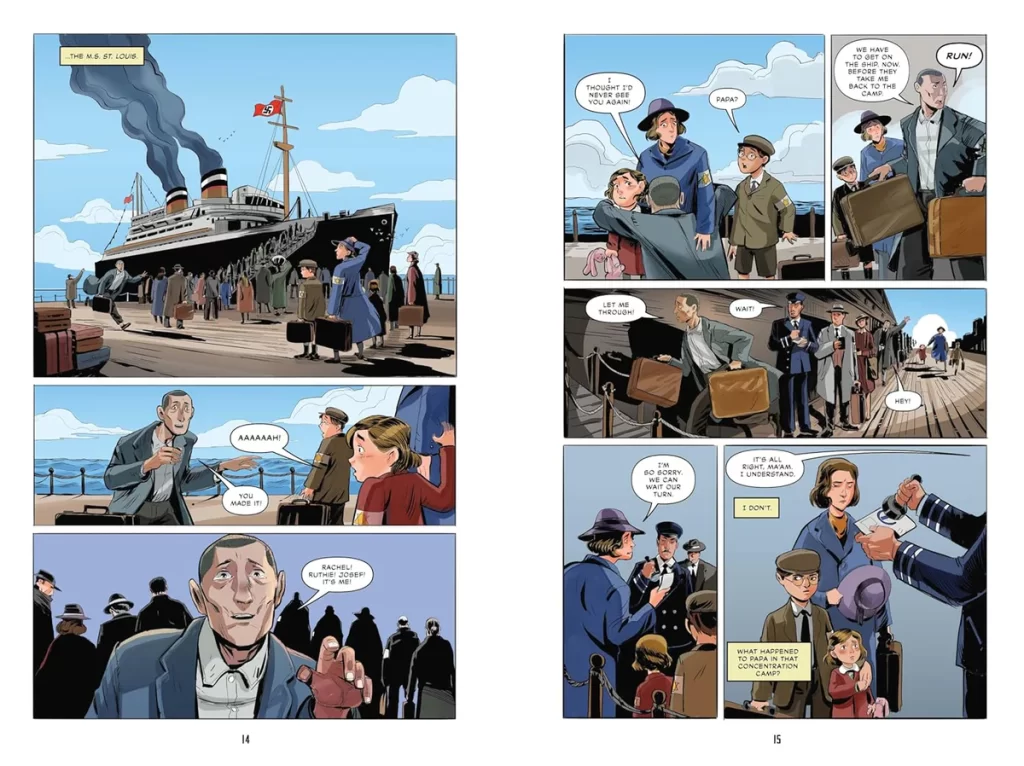
First up there’s Josef. He and his family live in Berlin, Germany, in 1938. His father is taken away one night by the Nazis as he continued to practice law, despite it being forbidden for Jewish people to do so.
Next is Isabel, who lives with her family in Havana, Cuba, in 1994. With the collapse of the Soviet Union in 1991, which was providing Cuba with food, the people are starving. The Cuban dictator Fidel Castro refuses to allow anyone to leave however, and unrest is growing.
Finally, there is Mahmoud, who lives with his family in Aleppo, Syria, in 2015. The country is being ruined by civil war, as Syria’s dictator Bashar al-Assad turns his military against his own people in the wake of the Arab Spring (a pro-democracy movement) that spread across the Middle East.
The book focuses on each character in turn, a chapter at a time (each a handful of pages). As you can see from the outline above, the reasons for leaving vary across the three settings. For each though, there’s a final straw that leads to their decision to go, followed by a harrowing journey.
To say they are the same would be wrong though. Each group goes through a similar process yes, but have experiences that differ in their details. Sadly though, there is often a promise of freedom that gets horrible dashed; despite horrors and setbacks however, they keep on pushing and struggling.
Although the three children depicted in the stories are themselves fictional (as explained in the author’s note in the back), their situations are based on real events, real records, and real stories. For example, what happened with the German ocean liner MS St. Louis in 1939 is devastatingly true.
I appreciated the three different settings, especially having one that is so recent (recent to the original book’s publishing date anyway). Children will often hear about refugees fleeing war and conflict, but without any context that could turn it from a general situation into something more real.
The graphic novel is adapted from the New York Times bestseller of the same name, also by Alan Gratz, written for older middle-grade readers in 2017. This new version is an accessible way for younger readers to learn more about why someone would need to leave their home, and what refugees often go through.
Given how many refugees still flee their countries today, and how many situations and regimes are still dire (Bashar al-Assad was only overthrown two years ago, in 2024!), this adaptation is a great way to introduce difficult topics and encourage discussion.
Fini’s art is the perfect accompaniment; he has a way of infusing every image with life, whether it’s the joy and love of a quiet moment or reunion, the fear of another tragedy, or the horror of being treated brutally and harshly for no good reason.
Reading these stories is hard at times, of course it is. It’s easy for people to look away, and plenty of people in the stories do, whether due to fear, or hatred, or discomfort. Looking away may be a very human reaction, but that doesn’t make it right – and I think that’s a good lesson to teach.
The humanity these stories show is a stark reminder to all of us – younger and older readers alike – that we shouldn’t need to experience it or see it directly to empathise. Rather, we should ALL remember that behind these stories are just people, people who just want to be safe with those they love.
And how could anyone begrudge others for that?
If you want to learn more, you can grab a copy of Refugee: The Graphic Novel at the link below.
(Disclosure: If you buy books linked to our site, we may earn a commission from Bookshop.org, whose fees support independent bookshops.)
Interested in more books about social issues? You can see our previous reviews here.
