

By Lisa Heathfield (Andersen Press, May 2026)
‘I’m so tired of holding up my world, Cooper,’ I say quietly.
‘I get that,’ he says.
He looks at me and I know he does. There are so few people who really do. Who know what it’s like to be alone and drowning in a system that wants to pass you to the next person and the next. How tiring it is to keep starting again.
16-year-old Dusty and her younger sister Poppy have been moved from foster home to foster home. Some have been quite bad, but at least they’ve always had each other. Until one day when things go too far, and the two are separated. Dusty is sent to a children’s home, while Poppy is taken in hundreds of miles away.
Desperate to get out and be reunited with Poppy, Dusty hatches a plan with another unhappy teen at the home, 16-year-old Cooper. Soon they’re on the run, making their way across the country towards Poppy with the adults in hot pursuit…and growing closer to each other along the way.
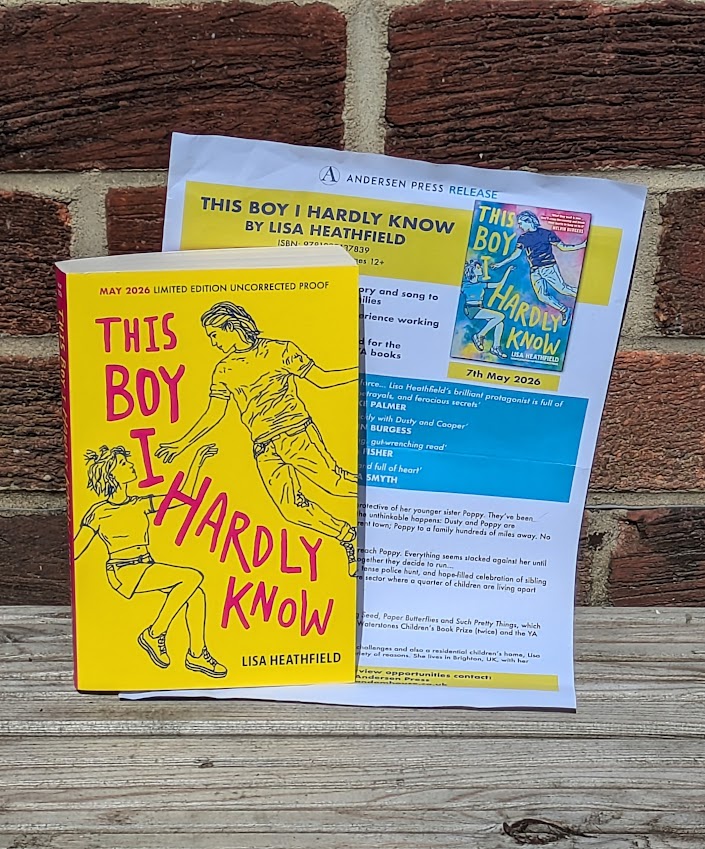
Thank you to Andersen Press for sending us this uncorrected proof copy – the final version was released earlier this month, and we’d encourage you to go pick it up!
This Boy I Hardly Know sounds like a YA, coming-of-age romance; the title itself references the boy that Dusty finds herself falling for. And it is that, but it’s also more – it’s a look at the care system, the vulnerability of being a teen with no real adult support, the trauma of abuse, and the joy that can be found with family, whether it’s a younger sister or a stranger that you unexpectedly connect with.
The early chapters really pull no punches when it comes to how foster kids are shuttled around, or separated from each other. It can happen so quickly, it’s no wonder that Dusty gets angry. Her stuff is already packed up and she’s not even allowed to say goodbye to Poppy. It’s enough to make your head spin.
At the start, Dusty just seems like an emotional teen, full of rage and disobedience, and at first I thought maybe her foster parents were simply stressed out by her ‘bad behaviour’. But that’s not it. The reality of foster care is that there are people who are just not suited to take in children, especially those who have complex needs due to neurodivergence or childhood trauma, but do so anyway.
And that’s before we even get to the children’s homes, the place where they put the kids who no-one wants or are able to deal with. Heathfield talks in her author’s note about seeing the adults put misbehaving children in ‘holds’ – physically restraining them, often pinning them against walls or holding their arms back until they hurt – something she portrays with both Cooper and Dusty.
We’d like to believe that things like this don’t happen, but most of us have no experience with the care system to truly state that. And, as the notes point out, children’s homes are businesses, not charities. Can you really provide the best level of care when everything – and everyone – has a monetary value?
Combine this situation with the fact that, for the first time in their lives, Poppy and Dusty have been separated, and it’s no surprise that she’d run. She knows that she’ll be okay, but is terrified that Poppy is at first left alone with their abusers, and then ‘moved on’ when she has an outburst; the outburst of a young girl who has recently lost her sister.
Throughout everything that Dusty and Cooper do, there runs the thread of reaching Poppy. They can’t spend literally every second running, but even when they’re having fun (as much as they can, considering!) Dusty is still thinking about when she can tell Poppy about it all, or the happy memories they share.
Both Dusty and Cooper can be impulsive and headstrong at times, but they both share a sensitivity and a creativity that has often been stifled (or literally confiscated in the case of Dusty’s art supplies). And they both ultimately want a stable life with those they love, which doesn’t seem like a lot to ask.
There are occasional updates once they’re on the run, breaks after a few chapters where we see them being tracked, conversations about them between others, or police reports after particularly bad decisions. Showing how close or far their pursuers are, and how certain things get pieced together gives us a rising level of tension throughout.
And I’ll be honest, Dusty and Cooper make a LOT of bad decisions that can be pretty frustrating! However, they actually make perfect sense in the setting: these are two traumatised teens, with no trustworthy adults that they can turn to for guidance or support. The treatment they’ve endured breeds a particular type of independence, one that doesn’t always end well.
This fuels a heartbreaking cycle of pain. They are abused, so they behave erratically or lash out, even at those who might be able to help them. This in turn leads to them being dismissed, or treated with suspicion, which simply proves to them that they’re right not to trust adults. Having been let down so many times before, they have to adopt this attitude in order to protect themselves.
It would be easy to write their experiences off with a “well, if they’d only done…” but no situation is ever that simple. Do I wish that Dusty had told Jen of their treatment at the hands of their foster parents? Yes! But I also understand why she didn’t. The risk of ‘causing trouble’ is that the next place might be worse, or the two sisters might even get separated.
I won’t lie, I felt a dull ache in my heart throughout a lot of the book; for the stress, the pain they go through, the trauma that obviously affects their actions. But these were punctuated by moments of beauty, peace, and freedom that I think we all – whether we’re intimately familiar with these situations or not – can recognise. The strong emotional response I had really shows how well it’s written.
This review is getting quite long, and I know I’ve spent a lot of it talking about how terrible the situation is. Heathfield’s background in the care system means she really knows what she’s talking about, and the numbers she shares in the author’s note about children in care is shocking. I won’t give the ending away, suffice to say that it’s bittersweet, and about the best result you could expect.
But this story is not about despair. Yes, it can be a tough read at times as it describes the broken system. But it also talks about the importance of caring for and supporting one another, of the families you make, and the hope that lies ahead even when everything seems bleak and the odds impossible. It’s about seeing these children – really seeing them. It’s not only written with experience, but also with heart, sympathy, and love.
The press release says it’s a beautiful story, and it’s not wrong. Maddening, distressing, joyful, hopeful…and beautiful. It’s a story we’d recommend anyone who works with children and teens read, to help them understand the realities of care and truly empathise with those on the other side.
If you want to run with Dusty and Cooper, you can grab a copy of This Boy I Hardly Know at the link below.
(Disclosure: If you buy books linked to our site, we may earn a commission from Bookshop.org, whose fees support independent bookshops.)
Looking for other books on current issues? Check out our previous reviews here.
