
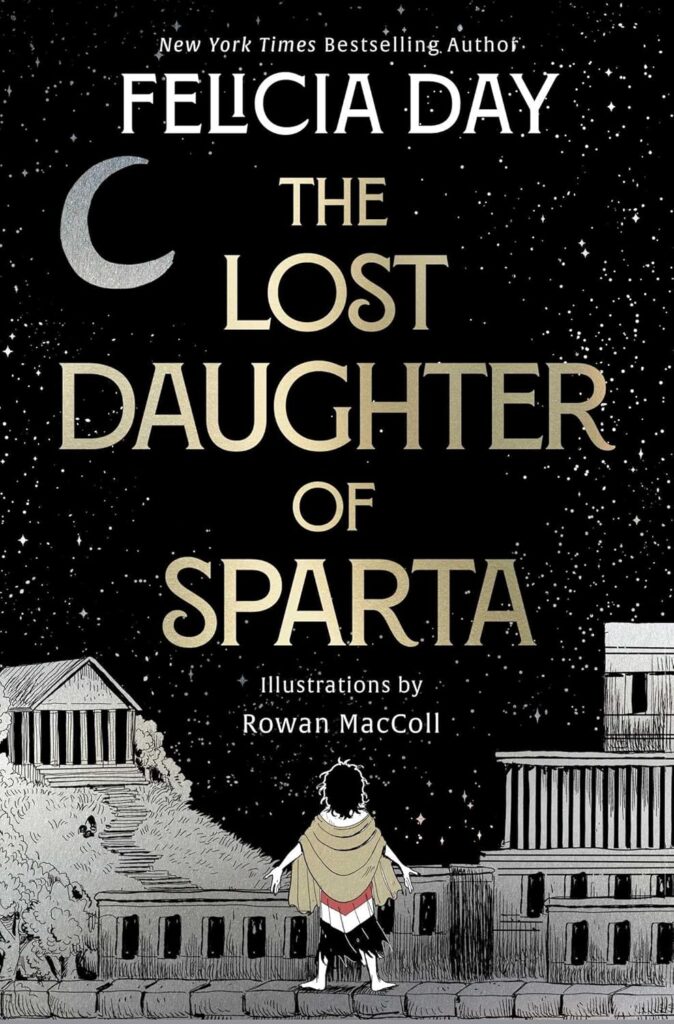
Written by Felicia Day, illustrated by Rowan MacColl (pub. Simon & Schuster, 2026)
“I’ll show him! I promise, I’ll be the best wife–”
“No, you won’t, child.”
“Huh?”
“You are twice cursed.”
“Twice…?”
“The daughters of the house of Tyndareus are fated to betray their husbands. Timandra was first, Helen second, then Clytemnestra. All my girls, powerless to stop themselves.
And you will be next.”
Such is the fate of our heroine, Philonoe. Born with a large red birthmark covering half her face, she is considered cursed and sent away to be cared for outside the city. She grows up exploring the forest, isolated from others.
When her parents call for her to return so she can be married, she is quickly disillusioned of the possibility they’re doing it out of love. So, when her mother tells her of the family curse, she sees her chance – to break the curse, be faithful to her new husband, and finally be accepted. It’s not going to be easy though, even with Artemis following her. And will it be enough?
I’m going to start this review by saying that I’m a classics and mythology nerd – I grew up on it, and studied it at university, which means I am simultaneously always interested in new interpretations and difficult to please. Keep that in mind going forward into this review!
For context, The Lost Daughter of Sparta is indeed that. Philonoe is mentioned only twice in ancient literature: once in a fragmentary genealogical catalogue attributed to Hesiod, and once in Apollodorus’ Bibliotheca. Very little is known about her beyond her family line, and her being made immortal by Artemis upon her death.
This makes her the perfect subject for a new story, and especially one told as a graphic novel. Rather than being full-colour or only black and white, we are treated to B&W with splashes of red on various items, people, or locations. It’s an incredibly effective style of drawing to make things stand out, including Philonoe’s birthmark – it can’t be ignored by the reader, just as it can’t be for her.
Our heroine is sad, lonely, and very relatable. She just wants to be loved, and is willing to go to the ends of the earth for it. She pleads to Aphrodite to lift the curse on her family so that she can be loyal and happy. Unfortunately for her, she’s a character in Greek myth, meaning that she’ll need to complete a number of challenges first.
So she embarks on her quest, shadowed by a sullen Artemis who is determined to show Philonoe that she doesn’t need anyone else’s approval. She’s approaching it in the way a god does however; although she is helpful, she is also insistent, arrogant, and unmoving.
To begin with, Artemis can’t understand Philonoe’s quest, or why she’d want to go through so much hardship. Watching Philonoe’s determination and resilience helps her soften, and she opens up about her own trauma in return. The growing affection between them is pure and chaste; neither of them quite understands what’s developing, and it’s never the full focus until towards the end.
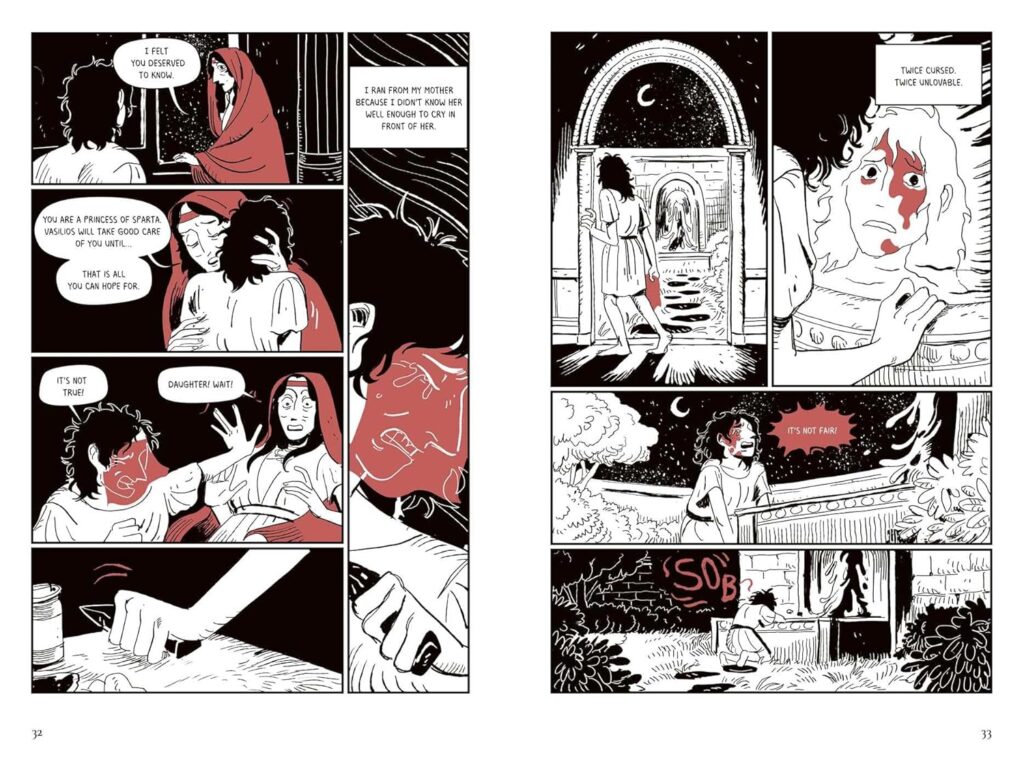
I enjoyed the style of the “hero’s journey”. It’s an exciting adventure, but in a way that makes a lot of sense for a female mythological character – more about sneaking and conversation than smacking things with a big sword. This gives our heroine the chance to connect with creatures very unlike herself, allowing them to change and develop her worldview.
Where liberties are taken with the myths, it is done so in a way that supports the story, in a similar vein to books like Madeline Miller’s Circe (which gets a shout out in the author’s note). The monsters here are portrayed at their most sympathetic, acting as a dark mirror to Philonoe who considers herself physically monstrous.
At the start of this review, you might remember me saying I’m hard to please with regards to modern retellings of myths. You might also notice that I’ve had nothing but praise for this book. Reinterpreting original myths is a challenge; for many of them, there is not much information, or there are conflicting versions.
What Day and MacColl have done here is taken the vibe of Greek mythology and given it their own shine. There is a modern sensibility to some of it, but I think that this is a strength – I found it tough at times being a myth-mad girl growing up, as non-goddess women were often overlooked. This does an admirable job to rectify that.
The Lost Daughter of Sparta wraps themes of loving and accepting yourself and, perhaps more importantly, not accepting harsh or unfair treatment from others in a fantastic dressing of Ancient Greece. It doesn’t shy away from the difficulties a woman in Philonoe’s position would face, but allows her the chance to pursue her own adventure. It’s exciting, moving, fun, and inspiring, and I wish I’d had a copy growing up!
If you want to adventure with Philonoe, you can grab a copy of The Lost Daughter of Sparta at the link below.
(Disclosure: If you buy books linked to our site, we may earn a commission from Bookshop.org, whose fees support independent bookshops.)
Looking for other books on mythology? Check out our previous reviews here.
