

By Don Brown (Clarion Books, imprint of HarperCollins Publishers, this format 2025)
Could Mariupol, and Ukraine, survive? As Russian rockets threatened the city, Ukrainians resisted, and with a heroic combination of sacrifice and bravery, the besieged city endured…for months. But it all came at a steep cost.
Was 83 Days in Mariupol what I expected when I opened this graphic novel? Honestly, I’m not sure. We’re very used to books either following a main story and characters, as in fiction, or giving us fact-files and specific information about individual things/places, as in non-fiction. But 83 Days… hovers neatly between the two.
Let me try to explain.
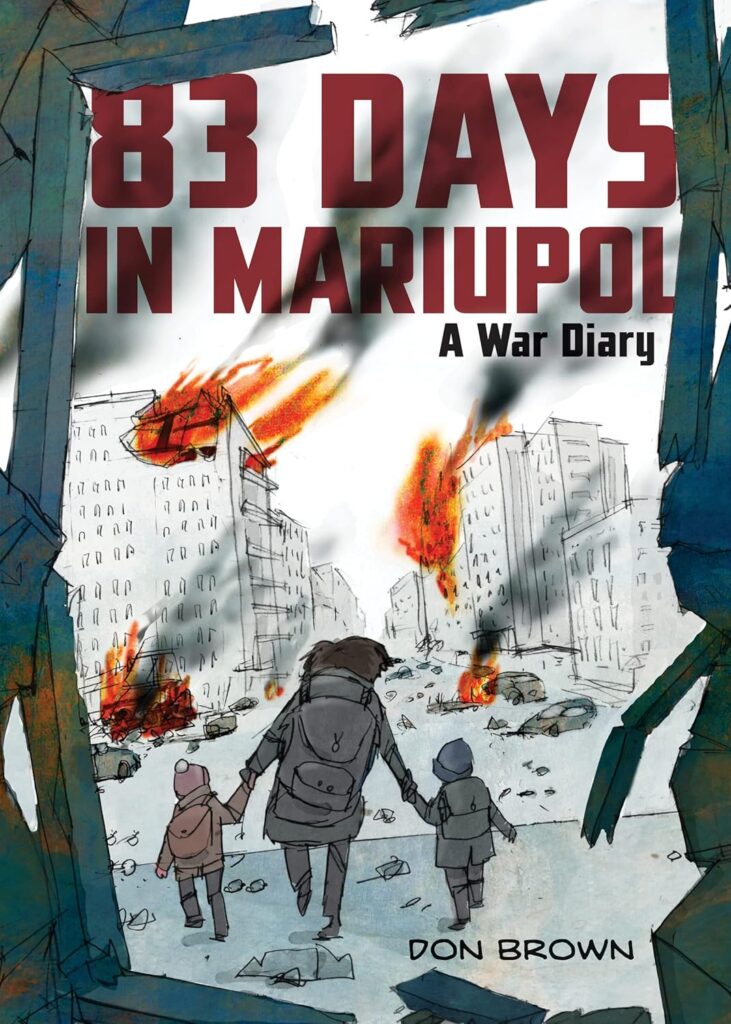
The “story” of 83 Days… begins with the 2022 instance of Russian aggression towards Ukraine, followed by the bombardment and invasion of the city of Mariupol, which sits close to the Russian border, on the Sea of Azov. It covers the three months from when Putin declared war to when the city of Mariupol was taken by Russia.
It’s a curious kind of storytelling. Although there is ‘top-down’ narration to explain what is going on, much of the imagery is set inside the city, amongst the civilians and the soldiers, the shelling and the fires. We ‘hear’ quotes from numerous Ukrainians throughout the book, all taken from genuine media pieces and news articles that were released at the time.
Although these individuals remain nameless in the book, knowing that these personal insights of life (such as it was) in Mariupol at the time are real is what gives the book its strength. We become desensitised to the big tragedies over time, which probably says a lot about humans and society, but the personal tragedies give you a sense of connection; they force you to empathise with the individual horrors on a level that is more than just the numbers lost.
The images themselves avoid depicting anything too graphic, but they certainly don’t shy away from the destruction, devastation, and the terror the Ukrainians experienced. The drawing style is rough, in shades of grey that feel cold, stark, and very effective. I also found it striking that the Russian troops are often depicted as faceless, or with their eyes shadowed.
There is also a prologue at the start of the book that is useful to give some history and context of the longer-term situation between Russia and Ukraine, as well as a map that includes a close-up of the city to show where the mentioned locations are – as someone quite poor at geography, I found this very helpful.
For younger readers, the situation in Ukraine may be their first real exposure to war, or at least a war that is covered in depth by the western media. The book really hammers home how quickly things escalated once Putin made his move.
The first imprint of this book was published in 2023, and the afterword notes the situation as it was at the start of that year. It’s disheartening to think that three years later it is still going. 83 Days… is an important reminder of the bravery of Ukraine and her people, to stand up against a bigger foe who many thought would roll over them in a matter of weeks.
Despite not being graphically depicted, war is still a difficult subject, and this is no exception. We understand that not all the important reads are easy ones, but it’s worth keeping in mind the subject matter when recommending it. As a result, we’d suggest that this is suitable for teens/secondary level readers.
One final point to note is that, despite the ‘War Diary’ subheading, the author has not been physically present in Ukraine during the war itself. While this didn’t diminish the book’s impact for me, some readers may prefer accounts from those more directly connected to the events.
If this is you, or a young reader you know, then it’s worth picking up a copy of You Don’t Know What War Is, a diary by 12-year-old (at the time) Yeva Skalietska who lived in Kharkiv when the war started. Her entries are accompanied by photographs, personal messages, and a map tracking the progress she and her grandmother made on their way to safety in Dublin.
It’s important for those outside Ukraine to be informed, and to truly understand that this is a situation happening to people just like us, right now. 83 Days in Mariupol is a great way to share this information, and we’d recommend it as a good starting point for those who want to learn more about the human cost of the invasion, and the ongoing resilience of the Ukrainian people.
If you want to learn more about the 83 Days in Mariupol, you can grab a copy of the book at the link below.
(Disclosure: If you buy books linked to our site, we may earn a commission from Bookshop.org, whose fees support independent bookshops.)
Looking for more stories about war? You can check out our previous reviews here.
