
By Beth O’Brien (pub. HarperCollins Children’s Books, 2025)
I felt rebellious saying it, like I was swearing. It felt wrong, dangerous, and Grandmother seemed to sense my discomfort.
‘When nature shows her strength, men will go to great lengths to call it evil,’ she said. ‘Magic is everywhere, Red. And while I do think it’s better that you keep these wolves a secret – from your mother and even Aerona – I want you to remember, no matter what happens, that this magic is much, much older than the fear of it, you hear me?’
Everyone knows that the woods are dangerous – full of strange magic and bloodthirsty wolves. Red doesn’t care though; she feels at home among the trees, and with the wolves that her grandmother taught her to summon.
But one day the woodcutter doesn’t return. Wolves only attack men, meaning she should be safe…so when her body is found, it throws the village into panic and fear. But there’s far more going on with the woods and the village than they all realise. And it seems that Red and her missing grandmother may be an important part of it.
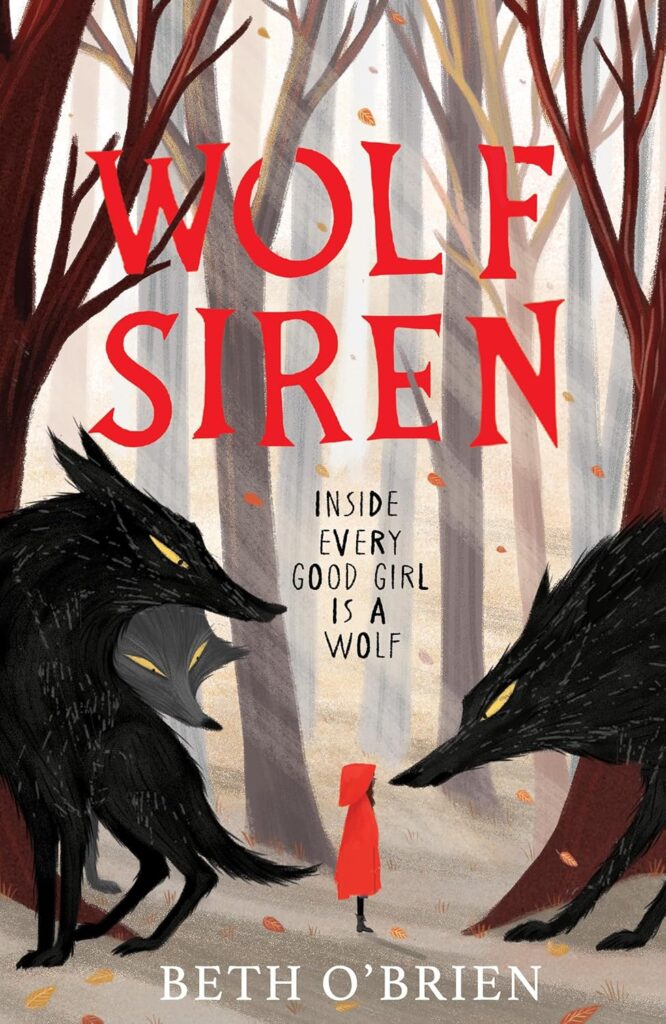
Wolf Siren is not a retelling of Little Red Riding Hood. But it’s not simply a rewrite either. Rather, it takes the classic fairy tale and turns it into something far more complex, something riveting, something utterly unexpected.
In the prologue, where we first meet Red, she has recently found her grandmother in the woods, the grandmother that originally disappeared long before she was born. She is only with them for a year, but during that time Red feels valued and seen – to be with someone who understands the woods like she does, who doesn’t shush her when she speaks of their magic.
By chapter one, it’s been three years since her grandmother went back into the woods and never came out. Red is now 13, and her connection with the woods and her wolves has only grown stronger, though she hides it from most of the village.
Red is visually impaired (as is O’Brien), but the trees help her navigate: a tug on the clothing here, a fallen log there, even vines and thorns when it senses danger. It’s an unspoken language that few can understand and, worse, many would brand as evil.
The magic of the woods is so beautifully described, and the peace that Red feels when she is there is almost palpable. You can genuinely feel why she prefers it there to the village! I almost wanted her to say sod it all and live out among the trees like the ‘witch’, Ms Blaeberry.
One of the only people Red can speak to about it is Caragh, the woodcutter, who was given the job as a punishment for rejecting the mayor’s marriage proposal. And if the latter part of that sentence makes you feel uncomfortable, trust me that’s the right feeling here.
When Caragh is found dead, apparently killed by a wolf, it gives the mayor the excuse he needs to step up the “protection” of the village. And since the woods helped Red find the body, she starts to draw the suspicions of the villagers, who whisper that maybe she was involved.
At the start of the book, Red’s mother tells her not to talk to people about the magic of the woods, as it would be disrespectful to the men who can’t enter them. The way she pauses as she speaks about it, and her desperation when she tries to get Red to behave is not borne out of respect however; it’s fear.
Not fear of the woods and the wolves. It’s a fear of the people, particularly the men (and especially the mayor) of the village. Red’s mother is broken, beaten down by their society and desperate to protect herself and her family. As an adult, I found myself empathising with her, even as I was cheering Red on.
Red is a delightfully wilful child, making her way in a world that she doesn’t fully understand yet. Her actions draw negative attention from the villagers, but it’s hard to fault her. She believes in standing up for what is right, though there is a question of whether at 13 she really understands the consequences her family would face.
If it feels like I’m being light on story beats, that’s deliberate – there’s a couple of big twists that I don’t want to risk going anywhere near in case I spoil them! Safe to say that I was gripped throughout, even when I felt frustrated, heartbroken, angry (which happened a fair bit!), or downright fearful of what would happen next.
Wolf Siren is a stunning story for older children that’s not just about the importance of connecting with the magic of nature, but also with ourselves. It’s about misogyny, superstition, family and community, and the pursuit and acceptance of truth – not just about the world, but ourselves and those around us too. And it’s about standing up for what’s right, even when the odds seem insurmountable.
They say it takes one person to stand up and make a change, but that’s not strictly true. One person doesn’t change things by themselves, not really. What they can do though is light a fire inside others: those who are frightened, or silenced, or downtrodden. It can show them that they’re not alone, and that together we can make a change. That is what Red stands for.
And if this is the message that we are teaching our children, through stories like Wolf Siren and others, then it makes me feel like there is hope for humanity yet.
If you want to walk in the woods with Red, you can grab a copy of Wolf Siren at the link below.
(Disclosure: If you buy books linked to our site, we may earn a commission from Bookshop.org, whose fees support independent bookshops.)
Looking for more fairytale fiction? Check out some of our previous book reviews here.
