
By Grace Lin (pub. Little, Brown and Company, 2023)
Almost all dishes on a Chinese menu have a story behind them. In a way, the menu at your Chinese restaurant is the table of contents for a feast of stories.
And this book is that feast.
Happy Year of the Fire Horse! We hope everyone has enjoyed the Lunar New Year, with all its colour, joy, and of course delicious food.
If, like us, you got caught up in all the delicacies available, then Chinese Menu is exactly the feast you need – it’s a stunning book, with fascinating stories to tell, based not just around traditional Chinese food but also how that food has changed and developed when taken across to America.
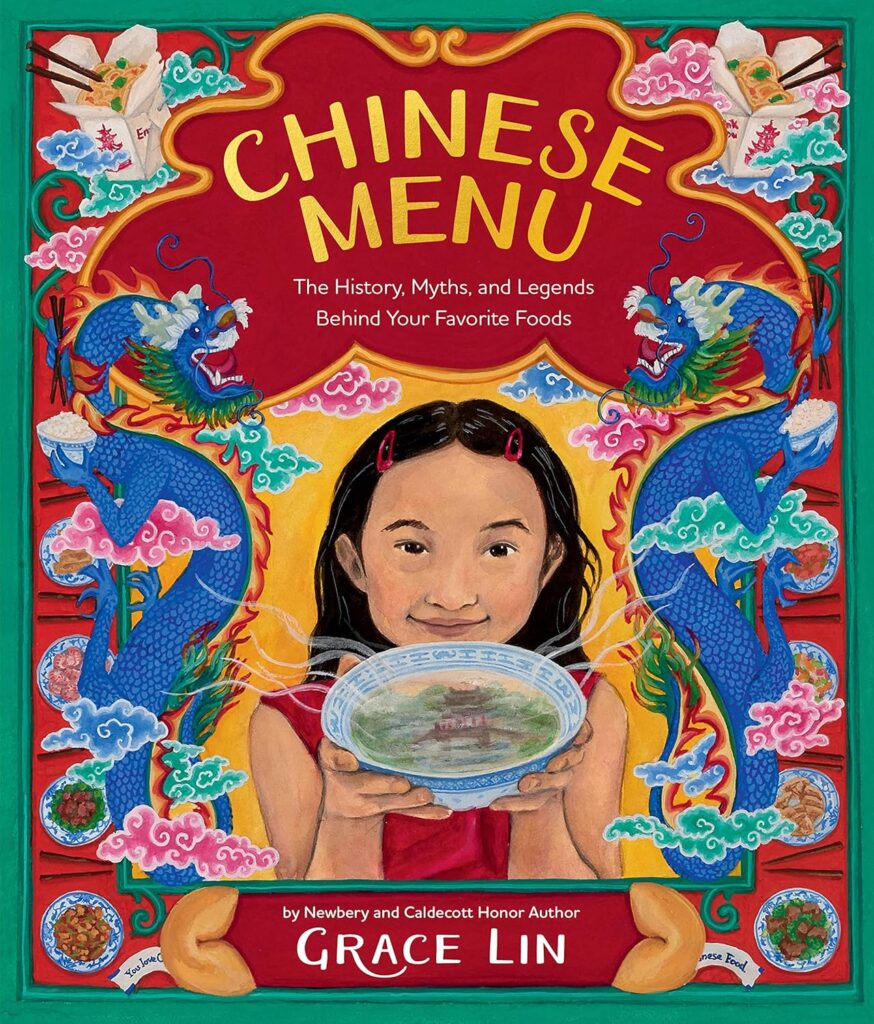
The book is broken up into themed sections: chopsticks, tea, appetizers, soup, sides, Chef’s specials, and desserts. Each one has an introduction, which includes small boxed drawings showing important information such as how to use chopsticks and tea etiquette, or examples of street food or sweet treats.
These sections turn out to be somewhat amusing in hindsight, as Lin explains that appetizers and dessert courses aren’t really a thing in traditional Chinese cuisine. They were both introduced when Chinese immigrants to the US saw what was expected by the American public when eating at restaurants, so they hurriedly filled the “gaps”, using street or festival food as starters for example.
Within each section there are several stories, and each of them has their own introduction. I found these very informative; they give the general historical background for the setting and some information on the food itself, along with some of Lin’s personal experiences and insight, before telling the story associated with it.
The tales themselves are fascinating, and come from a wide time period – some are as recent as the last 100 years, while others date back to four-figures BC. Though as with all good myths, there’s no exact placing them, and there’s always questions over which people existed and which didn’t. Who am I to say that the nine-tailed dog didn’t steal rice seeds from Heaven after all!
To reflect the ambiguity and the vagueness of information in many stories, Lin has included endnotes for each one that explain what she’s added or changed to make more sense, as well as variations she’s found (maybe the dog didn’t have nine tails for example). It’s an interesting insight into how stories vary or change over time and in different places.
Lin also explains in the front that she’s embellished some of the stories, or reimagined bits, but always in a way that is appropriate to the setting and the tale. For example, in many of the original tellings the female characters go unnamed, even when they play a pivotal role. Lin has done her research, and given them names that are fitting to the story – an excellent “change” in my opinion!
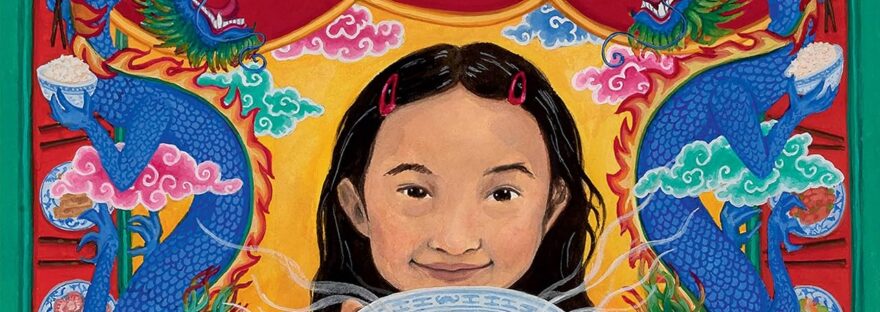
The book features full-colour illustrations throughout, and I love how fitting Lin makes the art to the different parts. For example, each section starts with a bright, modern image of one or two young girls enjoying or serving a relevant dish (these are modelled by the daughter of a friend, and her own daughter), who also feature on the dust jacket.
(A quick side note: the illustrations are fantastic, but so is the hardcover underneath the dust jacket! A vibrant red with a gold Chinese dragon immediately exudes charm.)
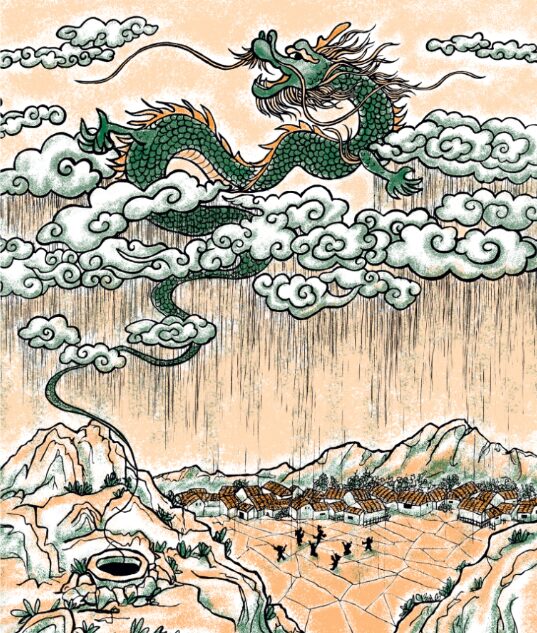
By contrast, the images that accompany the stories themselves are drawn in a much more traditional style with a simpler colour palette, though this doesn’t make them any less gorgeous. These appear at the start of each individual story, alongside full-page patterns, helping to clearly divide the book up.
Regular readers will know how much we love a good map, so I was pleased to get one here – I’ll confess that China is not somewhere I’m geographically familiar with. And even better, it was followed by a timeline that showed the different dynasties/eras, and when the various dishes in the book date to. I had a lot of fun referring to both as I read the stories!
Lin talks in the author’s note about how it feels to be an Asian American storyteller, and how important that dual identity is; how the original immigrants suffered and sacrificed, and how the stereotypes and racism are not entirely gone even now. She specifically wrote the book with American Chinese food in mind to make the point that societies and traditions change and develop. The food is a part of both Chinese and American cultures, just like so many of the people now are.
Along with the author’s note and endnote, there is an extensive bibliography of both general sources and story-specific sources, which gives a great jumping off point for those who are interested in reading more on Chinese myth and history, as well as American Chinese history and culture. There’s also a recipe for Lin’s mother’s scallion pancakes, which I look forward to trying out!
This is a joyful and fascinating book, that not only shares some captivating stories but also has something important to say about history and culture. A wonderful read for food, myth, and history fans alike!
If you want to join in the feast, you can grab a copy of Chinese Menu at the link below.
(Disclosure: If you buy books linked to our site, we may earn a commission from Bookshop.org, whose fees support independent bookshops.)
Interested in more books about different cultures? You can see our previous reviews here.
